
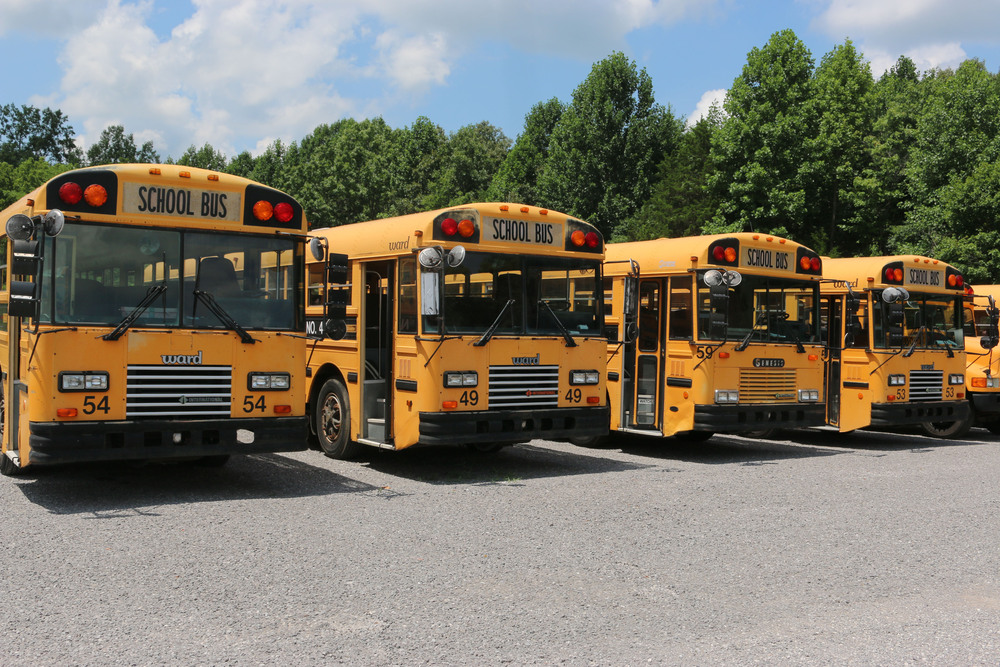
As Allen County students prepare to return to school, District transportation officials are reminding motorists that passing a stopped school bus is not only very dangerous—it can now result in an automatic fine under a new Kentucky law.
“Senate Bill 7 strengthens enforcement of school bus stop-arm violations,” explained Tommy Doss, the Director of Transportation for the Allen County Schools. “Under the law, the registered owner of an identified vehicle can receive an automatic $300 fine for a first offense and a $500 fine for a second offense. It’s a good bill. I hate for anybody to be out any kind of money, but we’re looking at a child’s life. The registered owner would then be responsible for disputing the citation if someone else was driving the vehicle.”
Doss emphasized that stop-arm violations remain a serious problem in Allen County and across the Commonwealth.
“We may have 15 violations on some days,” Doss pointed out. “This includes people passing school buses in parking lots and on the campus. Whether you’re two car lengths over or four car lengths over, unless there’s a brick wall between where you are and the bus, you must stop on campus. However, drivers may cautiously pass a parked bus displaying only its hazard lights---for example, a bus waiting to transport student-athletes to a game. However, once the red loading lights and stop arm are activated, vehicles must remain stopped until the signals are turned off.”
Still, off campus incidents happen as was the case early on a dark morning earlier this year, Doss recalled the frightening incident from the previous school year which occurred on Kentucky 101 and underscores the problem.
“A school bus had been completely stopped for approximately six seconds with its warning lights and stop arm activated when a vehicle drove past,” Doss recalled. “A child was preparing to step into the road, but the bus driver sounded the horn and the child’s father held the student back until the vehicle passed.
“There was plenty of time to stop,” Doss said, explaining that a review of the incident and the bus’s stop-arm camera revealed the vehicle appeared to have been at least an eighth of a mile away on a straight road when the bus stopped. “At some point, a child is going to lose their life, and I don’t want that to happen to any child.”
Doss encouraged drivers to slow down, remain alert and avoid distractions when approaching school buses.
“A bus stop for one child is probably 30 seconds long,” Doss said. “If we’re in that big of a hurry, we need to leave a little earlier.”
The law also addresses situations in which a driver illegally passes a stopped school bus but cannot be identified. Kentucky law now presumes that the vehicle’s registered owner or lessee was driving and may hold that person responsible for the penalties provided by law unless the presumption is successfully challenged.
On most Allen County roads, vehicles traveling both behind and toward a stopped school bus must stop when the bus’s red lights are flashing and its stop arm is extended. An exception applies on divided highways where opposing lanes are separated by a grass median, barrier or wall. Drivers traveling on the opposite side of the divided highway are not required to stop. However, vehicles traveling in the same direction as the bus must stop.
Doss said the District currently avoids loading and unloading students directly along 231 toward Bowling Green. Bus stops in that area have been adjusted so students can be picked up away from the main highway.
As the school year starts, 40 buses will run routes ranging from New Roe in western Allen County to Puncheon Creek in the hollers of the eastern part of the county. Doss said the district does not anticipate major bus route changes at the beginning of the school year. A few drivers may also move to different routes, while new drivers are being added to fill positions left vacant by retirements.
Doss touched on an issue that will remain fluid, perhaps even until the opening week. Construction around the middle and high school campuses could affect loading and unloading procedures, but the district currently expects to use a traffic pattern similar to the previous school year. Officials hope enough of the parking lot construction will be completed to allow buses to make their regular loop between the middle school and high school.
Parents/Guardians are reminded of both morning and afternoon procedures for buses makes stops at a home.
“Parents are encouraged to have children at their bus stops approximately five minutes before the bus is scheduled to arrive,” Doss said. “Students should wait in a safe location at least 10 to 15 feet away from the road while remaining visible to the driver. Because some buses arrive before daylight, Doss suggested that students use a phone light or another safe method to help the driver see them near dark driveways. Children should never cross the road until the bus has stopped, the stop arm is extended and the driver motions for them to cross. In the afternoon, preschool students must be transferred directly from the bus monitor to a responsible adult. For other young students, drivers must be able to see a parent or guardian before allowing the child to leave the bus.”
Drivers are instructed to always watch for anything out of the ordinary.
“If we pull up to a driveway and your fifth-grade child says, ‘I don’t know that car sitting in my driveway,’ the bus driver is going to keep the kid on the bus,” Doss said. “We’re going to assure safety in that situation."
Students are also asked to remain attentive, listen for their stops and help limit unnecessary noise. Doss noted that normal conversations among 50 students can quickly become loud and distracting for a driver who is already watching traffic, checking mirrors and monitoring students.
During the previous school year, district buses traveled approximately 460,000 miles. About 50,000 to 52,000 of those miles were for extracurricular and educational trips. Doss estimated that buses left the district’s lot approximately 620 times to transport students to athletic events, field trips and other activities.
“We’re looking for a safe and productive year,” Doss said.
Bus drivers will complete annual in-service training before the beginning of classes. Any questions about transportation can be addressed to Doss through the Central Office.