Allen County-Scottsville High School sophomores were challenged to make smart decisions while behind the wheel during a special Arrive Alive® presentation on Monday, March 30. Classroom-size groups not only heard a message on the dangers of distracted driving and driving under the influence of drugs or alcohol, but also what can happen without the use of seat belts during the daylong event. Both messages included hands-on activities to teach vital information to young drivers.
For years, safety presenters have used the Fatal Vision® goggles (commonly referred to as drunk goggles) to simulate the impact drugs and alcohol has on reaction time and judgement for a driver. Typically, students are asked to drive a golf cart while wearing the goggles---goggles that blur vision and can be set at different levels simulating different levels of intoxication. The Arrive Alive® program uses advanced technology to take the safety lesson to a higher level.
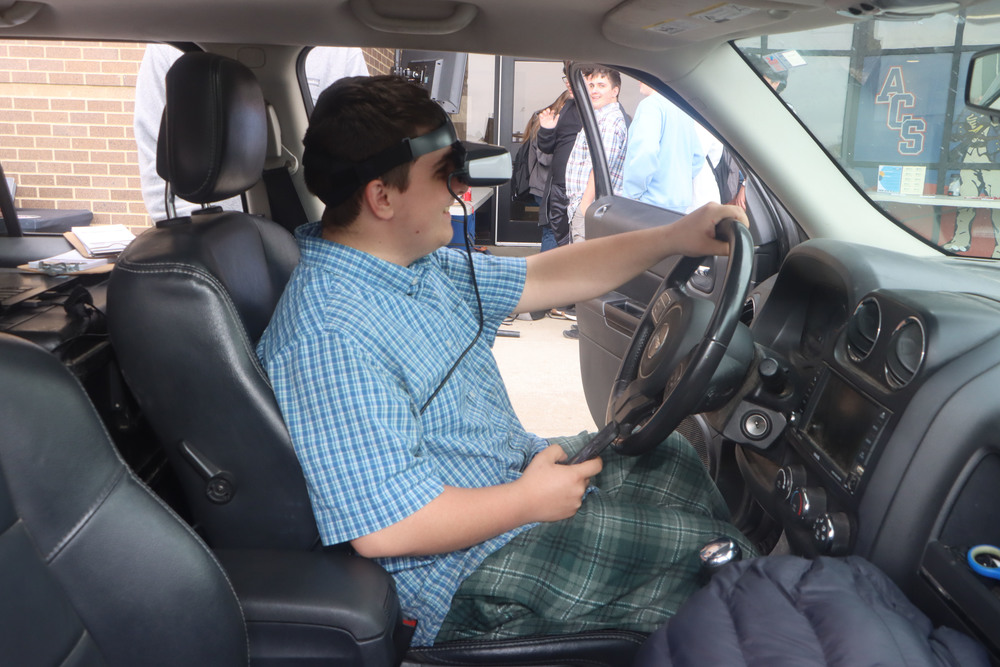
Arrive Alive® brought an SUV to use as part of the visual presentation. With the vehicles’ front wheels secured on blocks and locked in place to prevent movement, the SUV’s is wired with sensors which connect to Virtual Reality (VR) goggles worn by the student participant. A laptop simultaneously monitored the goggles and relayed the information to the Arrive Alive® technician.
“The students will get into the car one at a time and have the option to simulate driving drunk, drugged, or distracted driving by a cell phone,” explained Arrive Alive® event coordinator Jaylon Burris. “It’s meant to give the students a chance to see how dangerous that can be. There are bluetooth sensors on the gas pedals, brakes, and steering wheel. That's all they have control of. The driver will have on a VR headset that shows them the road they are traveling down. Behind us is a TV so that others can watch the driver’s turns and actions while they wait their turn.”
The hands-on engagement concludes with Burris playing the role of a law enforcement official.
“I write each one citations for each violation they have while going through the simulation,” Burris noted.
The simulation seeks to drive home the danger of risky behavior while operating a vehicle.
“We want the students to have a hands-on way to see how dangerous it can be if you get behind the wheel under the influence of drugs and alcohol or distracted by your phone,” Burris pointed out. “We think it's good for them to actually get behind the wheel of a car instead of just trying to walk through cones or putting on the drunk goggles. Those events can be helpful too but this actually puts them behind an actual wheel and shows them the dangers of putting themselves at risk for injury.”
Joining Burris was Carol Lucio with SADD (Students Against Destructive Decisions). Her role in Monday’s program was to talk with students about making the decision to always wear their seatbelts.
“I hope that students take away from this id that the most important thing you can do is buckle up,” Lucio explained. “Kentucky is the worst state in the nation for teen traffic fatalities. Right now, 90% of our youth fatal crashes, the victims were unbelted.”
In addition to sharing information, Lucio asked students to participate in the buckle up challenge. Teams of four students were challenged to see how quick they could buckle up in all four seats in an on-site SUV. The fun exercise reinforced ideas presented in a video explaining the importance of wearing seat belts.
Sophomore students were chosen to take part in the programs since many have just received or will be getting their driving licenses in the coming months.